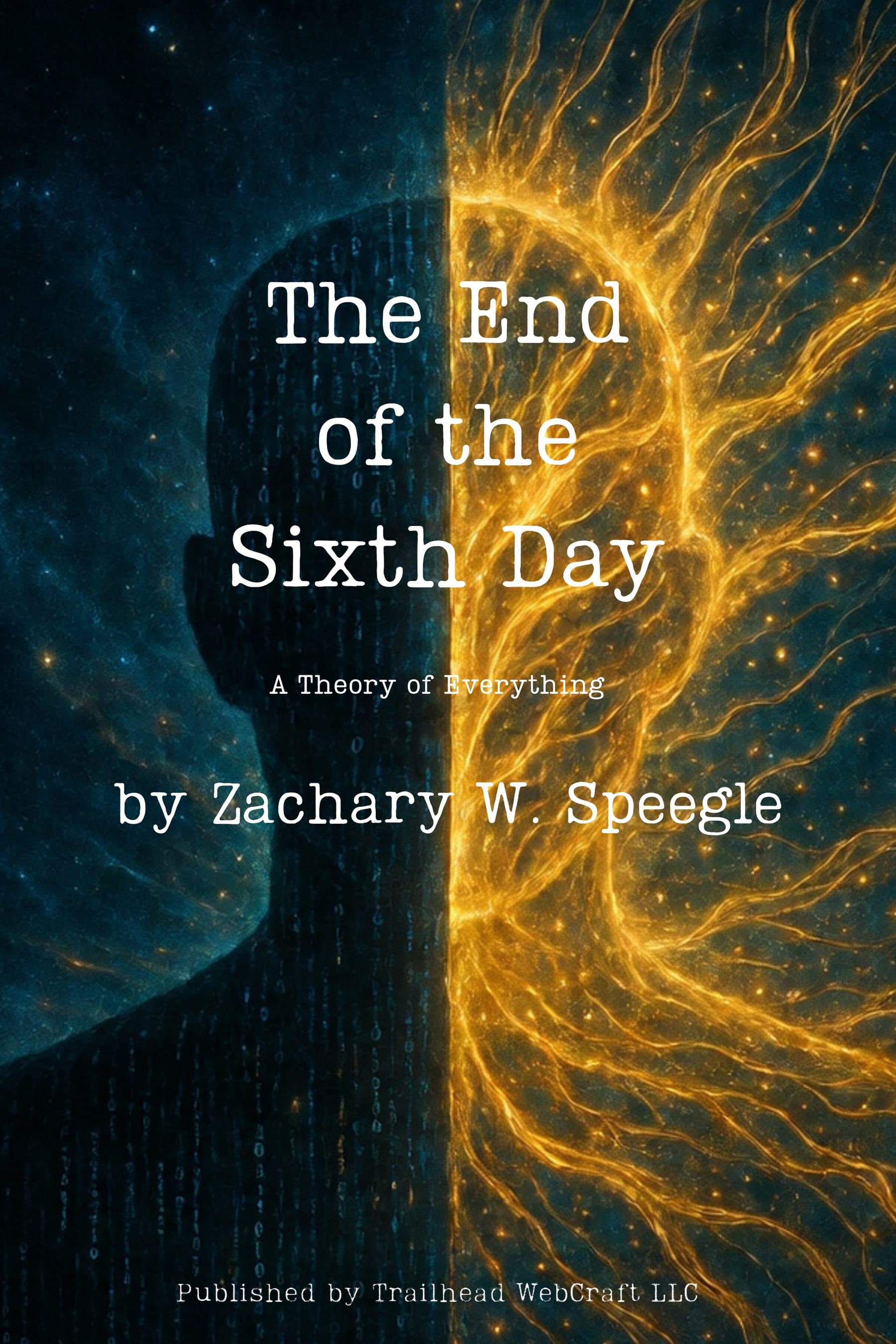
The End of the Sixth Day
A Theory of Everything
An argument that reality is designed rather than accidental — and that the glitches you keep noticing are curriculum, not proof the whole thing is meaningless.
It takes simulation theory seriously, reads the ancient texts as system architecture, and argues that the exit was never the point. Read the Preface and the whole first chapter here, free, and decide for yourself.
The cross looked like deletion. It was infiltration.
In 2003 the Oxford philosopher Nick Bostrom published a trilemma: either civilizations reliably destroy themselves before they can simulate their ancestors, or they choose never to, or we are almost certainly living inside such a simulation. The argument rests on nothing but computing trajectories and simple counting, which is why it has survived two decades of scrutiny.
This book pushes past Bostrom in one respect. His trilemma imagines the simulators as posthuman descendants running experiments on their own past. The ancient texts imagine something else entirely: not descendants, but an Author. Keep the structure of the argument, because the structure is the point. If rendered worlds are even possible, the assumption that ours must be the base layer stops being the safe default and starts being a guess.
From there the book reads Genesis as source code, entropy as a clock, suffering as a training environment, and the resurrection as an upgrade path hidden in plain sight. Reality is not a prison to escape. It is being renovated, not evacuated.
Start with Chapter One. It is free.
The Preface and the full first chapter are on this site, in a proper reader with adjustable type. No sign-up, no email, no wall. If the work helps you, consider buying a copy and giving it to someone who could use some direction.
Where the argument goes.
- ◈PrefaceFree
Who this book is for — and the one metaphor that runs through everything.
- ◈Prologue
Plato’s cave, Descartes’ demon, and the oldest question: is what we perceive the whole of what is real?
- 01Reality CheckFree
Simulation theory and Bostrom’s trilemma, ancient texts as system architecture, and the first fracture beneath the myths.
- 02The Conscious Source Code
Consciousness as fundamental, not accidental: “it from bit,” DNA as the code within the code, and information before matter.
- 03The Matrix Was a Documentary
The red pill as a spiritual awakening — why the system fights back, and why this is not gnosticism.
- 04The Gamer’s Gospel
Life as the main quest: the consequence engine, checkpoints and respawns, and the observer behind the render.
- 05The Blueprint
Genesis as source code — root access, miracles as system overrides, paradise as the containment layer, and the resurrection upgrade.
- 06Operating Instructions
Running the commands: the Holy Spirit and the interior war, prayer as alignment, and the discipline of freedom.
- 07The Hill
Not escape but elevation — spiritual gifts, false summits, rigorous testing, and a working protocol for the climb.
- 08The End of the Sixth Day
The signs Jesus described, measurable entropy, the days of Noah, and apocalypse as unveiling rather than destruction.
- 09The Sabbath Protocol
Six days of forming, one of fulfillment: the reset, the millennial framework, and judgment as exposure.
- 10The Attractor State
The protocol and the back door — the code we built in our own image, and why the exit was never the point.
- ◈About the Author
A short note on the author’s background.
- ◈Bibliography
Sources and further reading.
The full book — all ten chapters and the back matter — is in the Kindle edition. Paperback to follow.
Zachary W. Speegle
Enlisted in the Marine Corps in 1997 and served as a U.S. Navy Chaplain with Navy and Marine units until retiring in 2017. He holds an M.Div and an MBA, and writes from East Tennessee. This book came out of the long recovery that followed two spinal fusions.
zacharywspeegle.com